


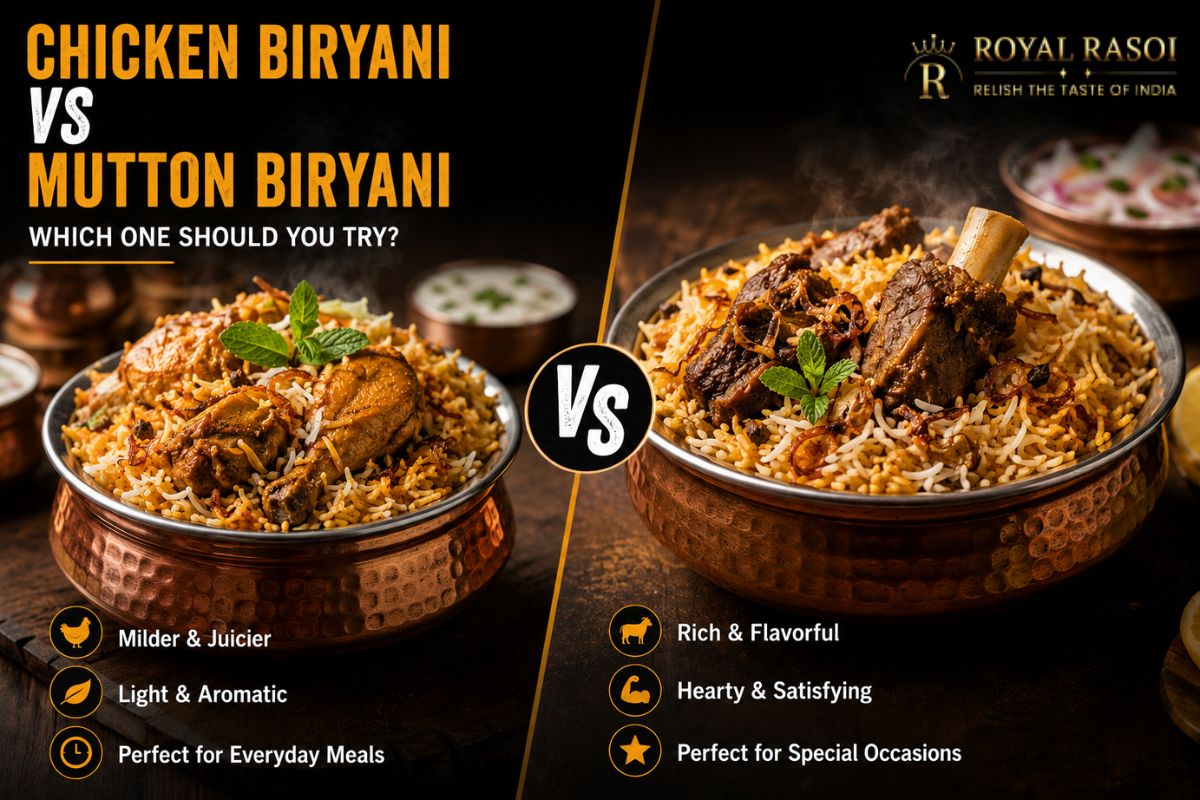

Chicken Biryani vs Mutton Biryani: Which One Should You Try?
Key takeaways
- Chicken biryani is comparatively quicker to prepare and takes the spice well, making it suitable for beginners.
- However, mutton biryani, while time-consuming, has its flavor enhanced with slow dum cooking.
- To add to the fine meal, mutton also gives higher calories, protein, iron, and vitamin B12 than chicken biryani.
- Royal Rasoi cooks them both classically, to allow customers to choose whichever option they feel like choosing.
What makes chicken biryani different?
Chicken is a meat that cooks easily, and therefore adds to the brevity of the biryani preparation. In general, chicken needs marination of 2 to 4 hours only, due to the fact that it gets tender very quickly. Additionally, layering it with rice and wrapping the pot for cooking takes only about thirty to forty minutes.
However, chicken absorbs marinade and spices quickly, which helps it combine perfectly well with the rice and creates a much lighter flavor. Besides, it does not take as long to cook chicken, as it can be quite soft even after a slightly shortened dum time.
Chicken biryani is good for people who have never tried biryani, as it is rather tasty but does not make the dish too heavy.
What makes mutton biryani different?
Mutton biryani is a delicacy that requires patience and time. The meat is first marinated overnight using yogurt and acid-based ingredients, which serve to make the meat tender before cooking. When using the dum method of cooking, mutton takes anywhere from 60 to 90 minutes to cook, based on the meat cut. Due to slow cooking, the meat becomes soft while also keeping its texture.
During cooking, mutton loses its natural fats, which produce the rich, deep, and smoky flavor that can hardly be matched by chicken. Leaving out key steps such as the marination process of mutton can result in tough and bland meat. Therefore, when cooked correctly, mutton biryani gives the best taste experience.
Chicken vs mutton biryani: side-by-side comparison
| Factor | Chicken Biryani | Mutton Biryani |
|---|---|---|
| Marination time | 2–4 hours | 8–12 hours (often overnight) |
| Cooking time (dum) | 30–40 minutes | 60–90 minutes |
| Texture | Soft, blends with rice | Firmer, holds its own |
| Flavor profile | Milder, spice-forward | Deeper, richer, meat-forward |
| Calories (per serving) | ~350–400 kcal | ~450–500 kcal |
| Protein | ~28–32g | ~30–35g |
| Best for | First-timers, lighter appetite | Experienced eaters, richer meals |
| Price (typical) | Lower | Higher |
Nutrition: which one is actually lighter
Chicken wins on paper, but the gap is smaller than most people assume. Chicken biryani generally runs 350 to 400 calories per serving with 28 to 32 grams of protein and lower saturated fat. Mutton lands closer to 450 to 500 calories, 30 to 35 grams of protein, and more saturated fat. The protein gap alone isn't big enough to decide anything.
Where mutton actually pulls ahead is micronutrients. It's higher in iron, zinc, and B12, which matters if that's what you're eating red meat for in the first place. Neither dish counts as diet food, and honestly, portion size probably matters more than which meat you pick. A small plate of mutton can land lighter than a large plate of chicken. The "healthier" option depends as much on how much you eat as what's on the plate. The best non-veg restaurants near Grand Plaza Hotel never disappoint you.
How to decide which one suits you?
No single right answer here, but a few questions usually settle it fast.
- First time trying biryani? Go chicken. Easier to enjoy without any prior context.
- Feeding a table? Mutton feels more like an occasion dish, worth ordering when people are sharing.
- Watching calories or cholesterol? Chicken's the lower-risk pick, though portion size still matters more than the meat itself.
- Want something rich after a long day? Mutton delivers weight that chicken just doesn't have.
- Can't decide? Order half portions of both if the kitchen allows it. Most places that take biryani seriously will do this without blinking, since enough people ask for it. Indian dinner restaurant Hanoi makes outstanding, delicious biriyani.
Where to try both in Hanoi?
Indian food in Hanoi has moved well past the small group of tourist-facing curry houses that used to be the whole scene. If you're hunting for the best Indian restaurants in Hanoi that actually cook biryani under dum, instead of just steaming pre-cooked rice and meat together and calling it biryani, the real list is shorter than search results make it look.
For anyone staying near the Old Quarter or French Quarter, finding an actual Indian dinner restaurant in Hanoi usually comes down to one question: does the kitchen slow-cook biryani at all, or does the menu just list it while the kitchen fires off a quick stir-fried version instead? That difference matters more than most reviews bother mentioning.
However, closer to the diplomatic area, the search tends to narrow toward the best non-veg restaurants near Grand Plaza Hotel, where a handful of kitchens have built a name specifically on meat-forward dishes rather than the vegetarian-heavy menus that dominate elsewhere in the city. Royal Rasoi falls into that group, running both chicken and mutton biryani through a proper dum process instead of cutting the timeline short.
If you're new to the city and don't know where to start, a good rule for finding the best Indian restaurant in Hanoi for tourists is simpler than it sounds: look for a menu that explains spice levels clearly and doesn't assume everyone wants it at full heat. Small detail, but it's usually the difference between someone's first Indian meal in Hanoi going well or putting them off the cuisine altogether.
Mistakes first-timers make
- Ordering the spiciest option to look adventurous. Biryani doesn't need to hurt to be authentic. Just ask the kitchen to dial it down if you're not sure.
- Stirring the rice too aggressively before eating. It's layered on purpose. Fold it gently instead of turning it into one uniform mush.
- Skipping the raita. It's not a throwaway side. It cools the dish down and makes the spice easier to sit with.
- Assuming all biryani tastes the same everywhere. Hyderabadi, Lucknowi, Kolkata style- they're different enough that comparing one restaurant's version to another's isn't always a fair fight.
Tips from someone who eats a lot of biryani
Order it fresh, never reheated. Biryani that's been sitting loses the layered texture that's the whole point of ordering it, and reheated rice tends to clump up. If a place can actually tell you how long the dum process ran, that's usually a decent sign nobody cut corners.
Additionally, don't judge a kitchen's biryani by how good its curries are. Plenty of places nail butter chicken and turn out mediocre biryani, because it's a different skill entirely, closer to technique and timing than spice blending. Menus lump the two together, but the kitchen skills behind them aren't really the same thing.
Bottom line
Chicken and mutton biryani aren't fighting for the same spot. One's quicker and easier to like on a first try. The other takes longer and pays you back for the wait. Whichever one you're leaning toward, look for a kitchen that treats dum cooking as something worth the time, not a step to rush through. Royal Rasoi cooks both versions the traditional way, so once you've picked what you're in the mood for, that's the part that actually decides whether the plate is worth it.
Frequently asked questions
1. Is chicken biryani healthier than mutton biryani?
On calories and saturated fat, yes. Mutton makes up ground on iron and B12, so it depends what you're optimizing for.
2. Which biryani is spicier, chicken or mutton?
Neither, really. Spice level comes down to the recipe and region, not the meat.
3. How long does mutton biryani take to cook?
Plan for 8 to 12 hours of marination and 60 to 90 minutes under dum. Chicken biryani is faster on both counts.
4. What's the best Indian restaurant in Hanoi for tourists new to biryani?
Look for a menu that spells out spice levels and leads with chicken biryani, since it's the easier dish to start with.
5. Can I order half chicken and half mutton biryani?
Usually, yes. Royal Rasoi and most kitchens that take biryani seriously will split a portion if you ask.
6. Is biryani the same as pulao?
No. Biryani is layered and cooked under dum with marinated meat. Pulao is a simpler, milder one-pot rice dish.
7. Where can I find a proper Indian dinner restaurant in Hanoi?
Ask whether the kitchen actually slow-cooks the biryani. A lot of menus list it but stir-fry it instead.
8. Are there good non-veg restaurants near the Grand Plaza Hotel?
Yes. A handful of kitchens in that area specialize in meat-forward Indian dishes, including dum-style chicken and mutton biryani.
9. Which biryani has more protein, chicken or mutton?
They're close. Mutton edges ahead slightly, but not by enough to build a decision around.
10. Should beginners start with chicken or mutton biryani?
Chicken. Milder, faster to cook, and it blends into the rice in a way mutton just doesn't.